Winter Char Dham Yatra in Uttarakhand: Where the Gods Go After the Temples Close
By – Rohit Thapliyal
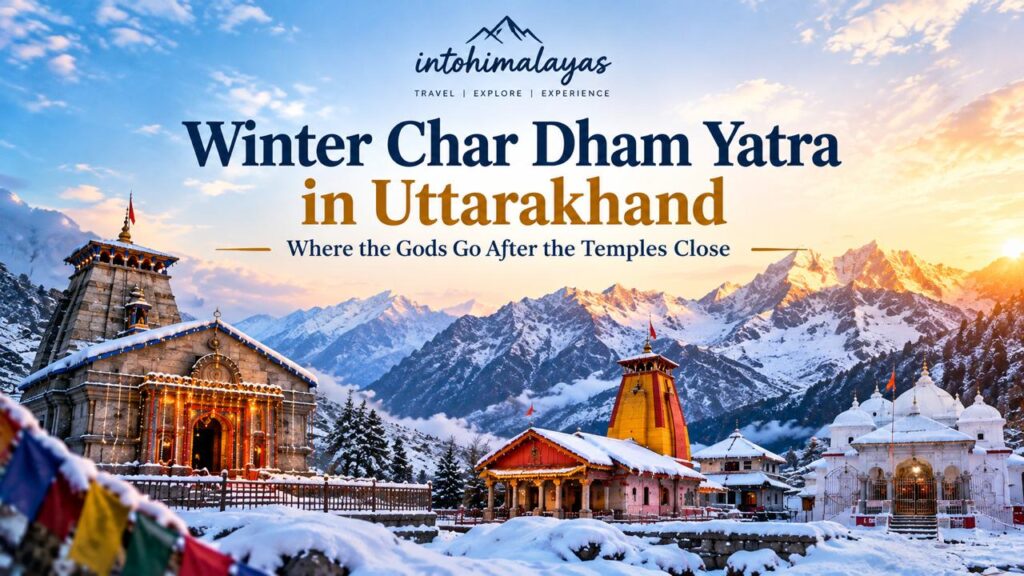
Table of Contents
Every year, as winter approaches the higher Himalayas, the doors of Kedarnath, Badrinath, Gangotri and Yamunotri close for the season. For many pilgrims, this marks the end of a long-awaited journey. But in Uttarakhand, the end of the pilgrimage season does not mean that worship comes to an end.
The deities associated with these four sacred shrines are worshipped at their designated winter seats in lower-altitude settlements. Lord Kedarnath is worshipped at Omkareshwar Temple in Ukhimath, the winter arrangements associated with Badrinath include Pandukeshwar and Joshimath, Goddess Ganga is worshipped at Mukhba, and Goddess Yamuna at Kharsali. These traditions form the basis of what is now promoted as the Winter Char Dham Yatra.
What makes this journey interesting is that it takes visitors beyond the famous temples and into the villages where religious traditions continue through the coldest months. There are ancient temples, stories passed down through generations, mountain roads and local communities that maintain these practices year after year.
If you are planning a trip in October or November 2026, the Winter Char Dham offers an opportunity to experience a different side of Uttarakhand’s religious life. Before travelling, however, it is important to understand where the winter worship takes place, how the traditions work and what you should know about visiting these places.
What Is the Winter Char Dham Yatra?
The traditional Char Dham pilgrimage in Uttarakhand takes devotees to Yamunotri, Gangotri, Kedarnath and Badrinath. These temples are located in the higher Himalayas, where winter snowfall, freezing temperatures and difficult access make regular worship and pilgrimage challenging.
When the main temples close for winter, the established religious traditions continue at designated lower-altitude temples. The deities or their worshipped representations are ceremonially brought to these winter seats, where priests perform the necessary rituals.
The Uttarakhand government began actively promoting the Winter Char Dham Yatra in 2024 to encourage winter pilgrimage and tourism. However, the religious traditions themselves are older than this tourism initiative.
For travellers, this distinction matters. The Winter Char Dham is not simply an alternative sightseeing circuit created for the off-season. It is an opportunity to visit places that already have an important role in the religious life of the region.
1. Ukhimath: The Winter Home of Lord Kedarnath
Ukhimath, in Rudraprayag district, becomes particularly important when the Kedarnath Temple closes for winter. The Panchmukhi representation of Lord Kedarnath is brought from the high-altitude shrine to Omkareshwar Temple, where worship continues during the winter months.
The transfer is not treated as an ordinary journey between two temples. It involves a ceremonial procession, priests, devotees and traditional rituals. People gather along the route, and the arrival of the deity at Ukhimath marks an important moment in the local religious calendar.
A real example of this tradition was reported in October 2025, when the Kedarnath shrine closed for winter on Bhai Dooj. The deity’s procession departed for its winter seat, with a scheduled night halt at Rampur before continuing towards Ukhimath. Devotees could then continue offering prayers at Omkareshwar Temple during the winter season. This is a documented example of a living tradition rather than a story preserved only in religious texts.
Ukhimath also has its own religious history. Local tradition associates the area with Usha, the daughter of Banasura, and Aniruddha, the grandson of Lord Krishna. Their marriage is part of the stories associated with the region, although the narrative belongs to religious tradition rather than independently established local history.
The town is worth visiting even if you are not undertaking a pilgrimage. The temple architecture, surrounding mountain scenery and quieter winter atmosphere offer a different experience from the busy route to Kedarnath during the main season.
If you have already visited Kedarnath, Ukhimath helps you understand what happens after the famous shrine closes its doors.
2. Pandukeshwar and Joshimath: Continuing the Worship of Badrinath
The winter arrangements associated with Badrinath require a little more explanation because both Pandukeshwar and Joshimath have important religious roles.
Pandukeshwar is home to Yogadhyan Badri, one of the revered temples associated with the Badrinath region. It is also traditionally linked with the Pandavas of the Mahabharata. According to local tradition, the Pandava brothers worshipped here, and the name itself recalls King Pandu, their father.
These stories have been passed down through religious traditions, but they should be understood as traditional accounts rather than independently verified historical events.
Yogadhyan Badri is particularly significant because it allows visitors to explore a part of the Badrinath religious landscape that is often overlooked when people focus only on the main temple.
Joshimath, meanwhile, has an important place in the winter worship associated with Badrinath. Narsingh Temple is a major religious centre in the town, and winter arrangements can involve both Joshimath and Pandukeshwar.
The exact ritual arrangements should be checked with temple authorities before travelling, especially if you are visiting in November 2026. Do not assume that every ritual takes place at the same temple or that the schedule remains identical each year.
For travellers, these destinations can also be combined with a broader journey through Chamoli district, depending on road conditions and available time. Auli is another nearby destination, but it offers a different experience: one centred on mountain scenery rather than pilgrimage.
3. Mukhba: The Winter Abode of Goddess Ganga
Mukhba, near Harsil in Uttarkashi district, is the winter seat of Goddess Ganga when the Gangotri Temple closes for the season.
Gangotri lies at a higher elevation and becomes difficult to access during winter. The goddess’s worshipped representation is therefore brought down to Mukhba, where devotees can continue their prayers through the colder months.
The village has a special character of its own. Traditional houses, mountain surroundings and the nearby Bhagirathi River make it an interesting destination even for travellers who are not undertaking a formal pilgrimage. In winter, the surrounding landscape can become especially striking, although snow and road conditions vary from year to year.
There is also a local legend associated with Mukhba. According to a tradition recorded by Uttarakhand Tourism, Chaman Rishi rested here with Bhima, one of the Pandava brothers, while travelling to light the sacred fire for an Ashwamedha Yagna.
This is the kind of story that gives a Himalayan village a place in the wider religious imagination of the region. It should be presented as local tradition, not as a proven account of a historical visit.
For visitors, the most meaningful part of Mukhba is seeing how the village continues to serve as a centre of worship after Gangotri closes. The pilgrimage changes location, but the connection between the deity and the community remains.
If you plan to visit in November, check road conditions and accommodation around Harsil and Mukhba in advance. Winter weather can affect travel through this part of Uttarkashi district.
4. Kharsali: Where Goddess Yamuna Is Worshipped in Winter
Kharsali, also known locally as Khushimath, is the winter seat of Goddess Yamuna. When Yamunotri closes because of the approaching winter, the goddess’s worshipped representation is brought to Kharsali, where the traditional rituals continue.
The village is particularly interesting for its temple architecture. Traditional construction uses materials such as stone and wood, and Uttarakhand Tourism notes the use of a mortar made from lentils in the construction of a historic temple. These details offer a glimpse into building practices developed in a mountain environment.
Kharsali is also associated with the families and religious traditions connected to Yamunotri. The village is not merely a place where visitors arrive for photographs; it has a continuing relationship with the pilgrimage and the worship of Goddess Yamuna.
This is worth remembering when visiting during winter. The rituals are part of local religious life, and travellers should behave respectfully around the temple and during ceremonies.
The surrounding forests, traditional settlements and mountain scenery make Kharsali an appealing destination for those interested in the cultural side of Uttarakhand. However, do not assume that every outdoor activity or road will remain accessible in winter.
A visit here offers a different perspective on Yamunotri. Instead of seeing only the high-altitude temple during the summer pilgrimage, you get to understand the village that carries the tradition through the colder months.
What Makes the Winter Char Dham Different From the Summer Yatra?
The most obvious difference is the location. During the main pilgrimage season, devotees travel to the four high-altitude shrines. In winter, the focus shifts to the designated temples where worship continues.
The experience also changes. Summer pilgrimage routes can be busy, with large numbers of visitors travelling on similar schedules. Winter journeys may feel quieter, although visitor numbers vary, and popular winter seats can still receive many pilgrims.
There is also a stronger opportunity to explore local traditions. At Ukhimath, Mukhba, Kharsali and Pandukeshwar, the relationship between the temple and the surrounding community becomes more visible because the villages themselves are central to the winter religious calendar.
This does not mean the Winter Char Dham should be treated as a substitute for visiting the original shrines in every sense. The high-altitude temples have their own settings, histories and ritual significance. The winter pilgrimage offers a different way to remain connected with the same religious traditions.
Best Time to Visit the Winter Char Dham
October and November are the transition months, when the main temples close and the winter arrangements begin. The precise dates vary each year and depend on the religious calendar and official announcements.
If you are travelling in late October or early November 2026, check whether the relevant winter seat has begun its seasonal worship schedule. The closing of a high-altitude temple does not automatically mean that all winter arrangements are completed on the same day.
December through February can offer a colder Himalayan experience, but road conditions and temperatures require more careful planning. Snowfall is possible in the region, but it should never be assumed at a particular destination on a particular date.
For a first winter visit, it may be practical to focus on one or two destinations rather than trying to cover all four in a short trip. The distances, mountain roads and winter weather can make a rushed itinerary tiring.
Travel Tips for the Winter Char Dham Yatra
Start by confirming the current ritual schedule with official temple or district sources. The winter seat, opening arrangements and timings should be verified for your intended travel dates rather than copied from an older itinerary.
Carry warm layers, particularly if you plan to travel early in the morning or remain outdoors after sunset. Temperatures can fall sharply in the mountains, and the weather in the valleys may be very different from conditions at higher elevations.
Check road conditions before leaving, especially after reports of rain or snowfall. Keep some flexibility in your itinerary and avoid relying on tight connections between remote destinations.
Accommodation and food options can be more limited in smaller villages than in major tourist towns. Contact your accommodation in advance, carry some cash and keep offline maps available on your phone.
Finally, remember that these are active religious places. Ask before photographing ceremonies or worshippers, follow local instructions and avoid disturbing rituals for the sake of a photograph.
Final Thoughts
The Winter Char Dham Yatra reveals a side of Uttarakhand that many travellers never see. When the famous high-altitude temples close, religious life continues in the villages of Ukhimath, Pandukeshwar, Mukhba and Kharsali.
The traditions associated with these places are maintained through rituals, local communities and stories passed down through generations. Some accounts, such as the Mahabharata associations of Pandukeshwar and the legend of Chaman Rishi at Mukhba, belong to the region’s religious folklore. Others, such as the annual ceremonial transfer of the Kedarnath representation to Ukhimath, are observable practices that continue today.
For anyone interested in Himalayan culture, the journey is about more than reaching four temples. It is an opportunity to understand how communities adapt to the seasons while preserving their religious traditions.
If you plan to visit in October or November 2026, check the latest schedules and road conditions before setting out. Take your time, speak respectfully with local people when the opportunity arises, and look beyond the famous names. Some of the most meaningful parts of a Himalayan pilgrimage are found in the places where the journey continues after the crowds have gone home.
– Rohit Thapliyal
for intohimalayas
Winter Char Dham Yatra in Uttarakhand: Where the Gods Go After the Temples Close
Tilu Rauteli: The Warrior Princess of Garhwal | History, Story & Legacy

Madho Singh Bhandari: The Brave Warrior and Engineer of Garhwal
Baijnath Temple Kangra: Shravan Celebrations at the Ancient Stone Abode of Shiva

Sham Valley Trek Ladakh – The Best Easy Monsoon-Proof Homestay Trek in the Himalayas
Hampta Pass Trek in July: A Journey from Green Monsoon Valleys to the Desert of Spiti

Best Solo Treks in Uttarakhand: 10 Himalayan Trails for Every Kind of Trekker
Kilkileshwar Mahadev Temple, Srinagar Garhwal: A Peaceful Shiva Shrine Overlooking the Alaknanda