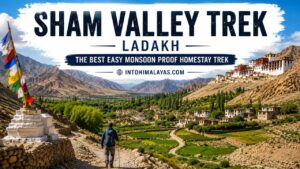
Sham Valley Trek Ladakh – The Best Easy Monsoon-Proof Homestay Trek in the Himalayas
By – Rohit Thapliyal
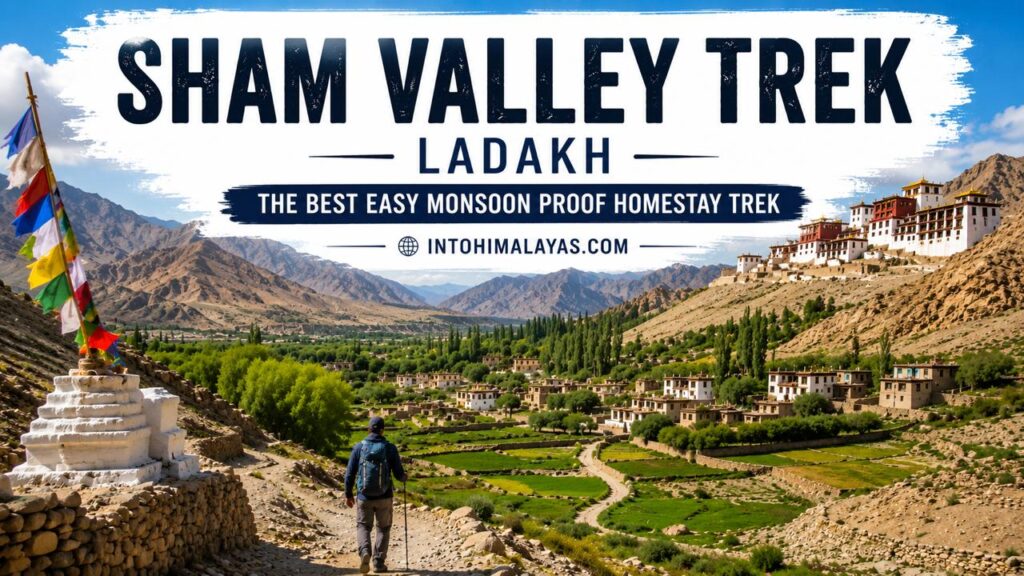
Table of Contents
The trek that changed my idea of Ladakh
Whenever someone mentions trekking in Ladakh, the first names that come to mind are Markha Valley, Stok Kangri, or Chadar. Even I had imagined Ladakh as a land of difficult mountain passes, endless barren landscapes, and challenging high-altitude adventures. But my journey on the Sham Valley Trek completely changed that perception.
Known as the “Baby Trek of Ladakh”, Sham Valley is anything but ordinary. It is one of those rare Himalayan treks where the destination isn’t a summit but the experience of walking through centuries-old villages, sleeping in traditional Ladakhi homes, sharing meals with local families, and watching life unfold at its own peaceful pace.
I planned this trek during the monsoon when most trails in Uttarakhand and Himachal witness heavy rainfall and occasional landslides. While the plains were drenched, Ladakh remained bright, dry, and welcoming. Looking back, I can confidently say that if you’re searching for an easy Himalayan trek that combines culture, history, and breathtaking landscapes without testing your endurance, Sham Valley deserves to be at the top of your list. If you’re still looking for greener Himalayan landscapes during summer, you can also explore our detailed guide to the Hampta Pass Trek, one of the most scenic crossover treks in the Indian Himalayas.
Why Sham Valley is the perfect monsoon trek
One of the biggest reasons I chose Sham Valley was the weather. Since Ladakh lies in the rain shadow region of the Himalayas, the Indian monsoon barely reaches here. That means clear blue skies, pleasant daytime temperatures, and dry trekking trails even in July and August.
Unlike many popular Himalayan treks where rain can interrupt plans, every morning in Sham Valley greeted me with crisp mountain air and endless views of brown ridges contrasting beautifully against patches of lush green villages. Walking under bright sunshine while the rest of North India struggled with rain felt almost surreal.
The best part? You don’t need to carry heavy camping gear. Every evening ends in a warm homestay where a Ladakhi family welcomes you with genuine smiles and freshly prepared local food.
Beginning the journey from Leh
After spending two days acclimatizing in Leh, I hired a shared taxi towards Likir, the starting point of the trek. The drive itself felt like a sightseeing tour. Prayer flags fluttered over mountain passes, whitewashed chortens stood quietly beside the road, and the Indus River accompanied us for much of the journey.
Before leaving Leh, I wandered through the old market to pick up a few essentials. I found myself spending more time than expected inside Ladakh Book Shop, browsing books on Ladakhi history, monasteries, and mountain culture. Just a few steps away, I stopped for breakfast at Gesmo Restaurant, where fresh apricot jam, warm bread, and coffee became the perfect start to the adventure. Later that evening, I also tried dinner at The Tibetan Kitchen, a place every local seemed to recommend.
Conversations with shopkeepers were perhaps the most memorable part. Nobody appeared to be in a hurry. People smiled easily, offered directions without being asked twice, and shared stories about the villages I was about to visit.
Walking towards Likir – where Ladakh slows you down
The trek officially begins near Likir Monastery, one of Ladakh’s oldest monasteries. Standing beneath its giant golden Maitreya Buddha statue, I watched monks quietly moving between prayer halls while the sound of spinning prayer wheels echoed through the complex.
A local elder told me something I still remember.
“In Ladakh, mountains are never empty. Every mountain has a protector spirit. Before beginning a long journey, we always offer a silent prayer.”
It wasn’t presented as folklore but simply as a way of life.
Even today, many Ladakhi families believe that respecting mountains, rivers, and ancient trees brings harmony during travel. That’s why you’ll often notice prayer flags tied near passes and mani walls lining the trails. Locals always walk around these sacred structures in a clockwise direction as a mark of respect. Naturally, I followed the same custom throughout the trek.
Leaving Likir behind, the trail climbed gradually over rocky ridges before opening into wide valleys that looked almost untouched. Unlike crowded Himalayan treks, there was no rush here. Sometimes an hour would pass without seeing another trekking group.
Instead, I crossed smiling villagers carrying fodder, children returning from school, and elderly women working quietly in barley fields.
It reminded me that Ladakh isn’t just about dramatic landscapes—it’s about people who have learned to thrive in one of the harshest environments on earth.
The first Ladakhi homestay experience
By late afternoon, I reached Yangthang, a peaceful village tucked between rugged mountains.
This turned out to be my favourite part of the entire trek.
The homestay wasn’t luxurious. Thick mud walls kept the rooms naturally warm, colourful carpets covered the wooden floors, and family photographs decorated the dining room. It felt less like checking into accommodation and more like visiting distant relatives.
As evening settled in, we all gathered around the kitchen where the host prepared butter tea over a traditional stove. I had heard mixed opinions about its salty taste, but after hours of trekking in the cold mountain air, it was surprisingly comforting.
Dinner included skyu, a traditional Ladakhi pasta dish cooked with vegetables, followed by fresh apricots picked from the family’s orchard.
The host explained how almost every household stores dried apricots for winter when temperatures fall far below freezing. Nothing is wasted here. Every fruit, every crop, and every resource is valued because survival in Ladakh has always depended on careful planning.
Listening to these conversations while sharing dinner made the trek feel far richer than simply walking through mountains.
Through the villages of Sham Valley
The next morning was one I’ll never forget.
Golden sunlight slowly illuminated the barren peaks while village life had already begun. Women watered vegetable gardens, children waved enthusiastically on their way to school, and prayer flags danced gently in the cold breeze.
The trail towards Hemis Shukpachan passed through gentle mountain passes, small streams, and patches of willow and poplar trees that seemed almost magical against Ladakh’s otherwise rugged terrain.
One fascinating belief associated with Hemis Shukpachan revolves around the ancient juniper trees, locally called Shukpa. These trees are considered sacred, and many villagers believe they bless the land with prosperity and protection. Burning dried juniper during prayers is still a common tradition across Ladakh, and its fragrance often fills monastery courtyards during important ceremonies.
Walking beneath these centuries-old trees felt strangely peaceful. Whether one believes the stories or not, it’s easy to understand why locals hold them in such deep respect.
Unlike many commercial trekking routes, Sham Valley never felt staged for tourists. Every village was alive with daily routines rather than souvenir stalls. Elderly men chatted outside their homes, women spun prayer wheels while walking to nearby fields, and children greeted strangers with cheerful “Julley”—the universal Ladakhi greeting that means hello, thank you, and goodbye all at once.
That single word became part of my vocabulary before the trek ended.
More than the landscapes, it was this warmth that stayed with me. The mountains were magnificent, but the people gave them meaning.
And somewhere between the monasteries, barley fields, apricot orchards, and simple village homes, I realised why Sham Valley isn’t just another Himalayan trek. It’s an experience that quietly teaches you to slow down, observe more, and appreciate the beauty of ordinary mountain life.
If you’ve already explored lush Himalayan trails like the Hampta Pass Trek, where forests, waterfalls, and alpine meadows dominate the scenery, Sham Valley offers a completely different perspective. Here, the beauty lies in silence, ancient Buddhist traditions, timeless villages, and a landscape that appears barren at first glance but slowly reveals its soul to anyone willing to walk patiently.
Reaching Temisgam – A peaceful end to an unforgettable journey
The final morning of the trek was perhaps the most relaxing. By now, my body had adjusted to the altitude, and the slow rhythm of village life had become familiar. There was no pressure to rush, no difficult climb waiting ahead, and no race to reach a summit. It was simply another beautiful day of walking through Ladakh.
The trail from Hemis Shukpachan to Temisgam gradually descends through quiet valleys, small mountain passes, and tiny settlements where life has changed very little over the years. Shepherds could be seen grazing their sheep and dzos, while long lines of prayer flags fluttered above old mani walls. Every now and then, I would stop without any particular reason—just to absorb the silence. It is surprising how quickly you begin to appreciate silence when you spend a few days away from roads and mobile networks.
As Temisgam came into view, surrounded by green fields against the backdrop of barren mountains, I couldn’t help but feel grateful that I had chosen this trek instead of chasing a more famous one. Sometimes, the easiest journeys leave the deepest memories.
Before leaving, my homestay host handed me a handful of dried apricots for the road and simply said, “Julley, come again.”
That simple farewell summed up the spirit of Ladakh better than any guidebook ever could.
The culture that makes Sham Valley special
What impressed me the most about Sham Valley wasn’t just the scenery—it was the way people continue to preserve their traditions.
Most villages along the trek follow Tibetan Buddhism, and monasteries remain the centre of community life. Prayer wheels are spun every morning, butter lamps are lit inside temples, and colourful prayer flags are believed to carry blessings and positive intentions into the wind. Locals often avoid pointing their feet toward religious objects, and they respectfully walk around stupas and mani walls in a clockwise direction. These are small gestures, but following them shows respect for the local culture.
Agriculture also remains an important part of daily life. During summer, villagers grow barley, wheat, peas, potatoes and vegetables in small irrigated fields. Apricot trees are found in almost every village, and if you visit during the harvest season, you’ll often be offered fresh fruit straight from the orchard. Refusing isn’t considered rude, but accepting with a smile always leads to a pleasant conversation.
One thing I noticed throughout the trek was how genuinely welcoming people were. Tourism has reached these villages, but it hasn’t changed their hospitality. Every “Julley” felt sincere, every meal was cooked with care, and every conversation reminded me that travel is ultimately about people rather than places.
How to reach Sham Valley Trek
Reaching the starting point is straightforward.
The nearest airport is Kushok Bakula Rimpochee Airport in Leh, which has regular flights from Delhi, Chandigarh and a few other major Indian cities. If you enjoy road trips, you can also reach Leh via the Srinagar–Leh Highway or the Manali–Leh Highway, though both routes are seasonal and generally open from late spring to early autumn.
Spend at least two days in Leh before beginning the trek. At an altitude of around 3,500 metres, proper acclimatisation is essential. Rushing straight onto the trail can lead to altitude sickness and may spoil the experience.
From Leh, shared taxis and private cabs regularly travel to Likir, the usual starting point of the Sham Valley Trek. After completing the trek at Temisgam, you can easily find transport back to Leh.
Best time to visit
The trekking season usually runs from May to September, but if you ask me, July and August are the best months.
While many famous Himalayan trails in Uttarakhand and Himachal Pradesh receive heavy rainfall during the Indian monsoon, Ladakh remains largely dry because it lies in the rain-shadow region of the Himalayas. This makes Sham Valley one of the most reliable trekking options during the monsoon season.
Days remain pleasant for walking, evenings are cool, and clear skies make photography especially rewarding.
How difficult is the trek?
One of the reasons Sham Valley has become so popular is that almost anyone with a reasonable level of fitness can complete it. The trek covers roughly 25–35 kilometres, depending on the chosen route, over three to four days. Daily walking hours are moderate, and there are no technical sections or glacier crossings. Families, beginners and solo travellers often choose Sham Valley as their first Himalayan trek. That said, altitude should never be underestimated. Even though the trail is easy, staying hydrated, walking at a comfortable pace and acclimatising properly in Leh are essential.
What I spent during the trek
Compared to many organised Himalayan treks, Sham Valley is surprisingly budget-friendly. My homestays, including dinner and breakfast, were affordable and offered far more value than any hotel could. Shared taxis from Leh helped keep transport costs low, while lunches during the trek were usually simple meals prepared by the homestays or small village kitchens. Since there is very little commercialisation on the route, I hardly spent money on unnecessary things. In many ways, that’s part of the charm—you learn to enjoy the mountains without distractions.
A few practical tips from my experience
Carry a refillable water bottle instead of buying plastic bottles. Most homestays provide filtered or boiled drinking water.
Start walking early each morning. The weather remains pleasant, and you’ll have enough time to enjoy villages without feeling rushed.
Always greet locals with a cheerful “Julley.” It’s amazing how quickly it opens conversations.
Respect monastery rules, ask before photographing people, and avoid littering. These villages have remained beautiful because the people take care of them.
Finally, don’t overpack. Since you’ll be staying in homestays, you won’t need camping equipment, making this one of the lightest Himalayan treks you’ll ever do.
Final thoughts
Sham Valley isn’t about chasing the highest pass or ticking another trek off a list. It’s about slowing down and appreciating a different side of the Himalayas.
I returned with countless photographs of monasteries, barley fields and dramatic landscapes, but what I remember most are the little moments—a warm bowl of skyu after a long walk, the fragrance of burning juniper near a monastery, children shouting “Julley” from across the fields, and evenings spent talking to Ladakhi families over butter tea. If your idea of travel goes beyond collecting destinations, this trek will stay with you long after you’ve returned home.
And if you’ve already explored lush Himalayan adventures like the Hampta Pass Trek or are planning treks across Uttarakhand, make Sham Valley your next experience. It will show you that the Himalayas don’t always need dense forests or snow-covered peaks to leave a lasting impression. Sometimes, all it takes is a quiet trail, a welcoming village and the timeless simplicity of Ladakh.
Frequently Asked Questions
Is the Sham Valley Trek suitable for beginners?
Yes. It is one of the easiest treks in Ladakh and is ideal for beginners, families and anyone looking for a relaxed Himalayan trekking experience.
Can I do the Sham Valley Trek during the monsoon?
Absolutely. Since Ladakh lies in a rain-shadow region, Sham Valley remains one of the best monsoon trekking destinations in India.
Are homestays available throughout the trek?
Yes. Villages such as Yangthang, Hemis Shukpachan and Temisgam offer comfortable family-run homestays with traditional Ladakhi meals.
How many days are required for the trek?
Most trekkers complete the Sham Valley Trek in three to four days, excluding the recommended acclimatisation stay in Leh.
Is a guide necessary?
The trail is well-established, and many experienced trekkers complete it independently. However, hiring a local guide adds cultural insights and supports the village economy, making the experience even more rewarding.
Loved this guide? Explore more trekking stories, detailed itineraries and offbeat Himalayan destinations on IntoHimalayas.com, where I share firsthand experiences from Ladakh, Himachal Pradesh and Uttarakhand.
– Rohit Thapliyal
for intohimalayas
Winter Char Dham Yatra in Uttarakhand: Where the Gods Go After the Temples Close

Tilu Rauteli: The Warrior Princess of Garhwal | History, Story & Legacy

Madho Singh Bhandari: The Brave Warrior and Engineer of Garhwal
Baijnath Temple Kangra: Shravan Celebrations at the Ancient Stone Abode of Shiva
Sham Valley Trek Ladakh – The Best Easy Monsoon-Proof Homestay Trek in the Himalayas
Hampta Pass Trek in July: A Journey from Green Monsoon Valleys to the Desert of Spiti

Best Solo Treks in Uttarakhand: 10 Himalayan Trails for Every Kind of Trekker
Kilkileshwar Mahadev Temple, Srinagar Garhwal: A Peaceful Shiva Shrine Overlooking the Alaknanda