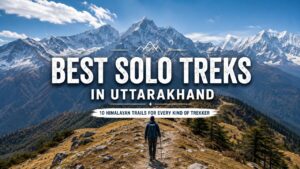
Best Solo Treks in Uttarakhand: 10 Himalayan Trails for Every Kind of Trekker
By – Rohit Thapliyal
Table of Contents
Solo trekking isn’t about proving that you can conquer a mountain alone. It’s about slowing down, walking at your own pace and experiencing the Himalayas without distractions. You decide when to stop for a cup of tea in a small village, how long to sit at a viewpoint, or whether to spend an extra hour watching clouds drift over a snow-covered peak. That freedom is what draws many trekkers towards solo adventures.
Having travelled across different parts of Uttarakhand, I’ve realised that the state offers some of India’s finest trails for independent trekkers. From short one-day hikes to multi-day Himalayan expeditions, there is something for every level of experience. At the same time, not every trek is suitable for going alone. Some routes are well-marked and frequently visited, while others demand high-altitude experience, navigation skills and proper planning.
In this guide, I’ve included only those treks that genuinely deserve a place on a solo trekking itinerary. Some are ideal for first-time trekkers, while others are better suited to people who already have experience walking in the Himalayas.
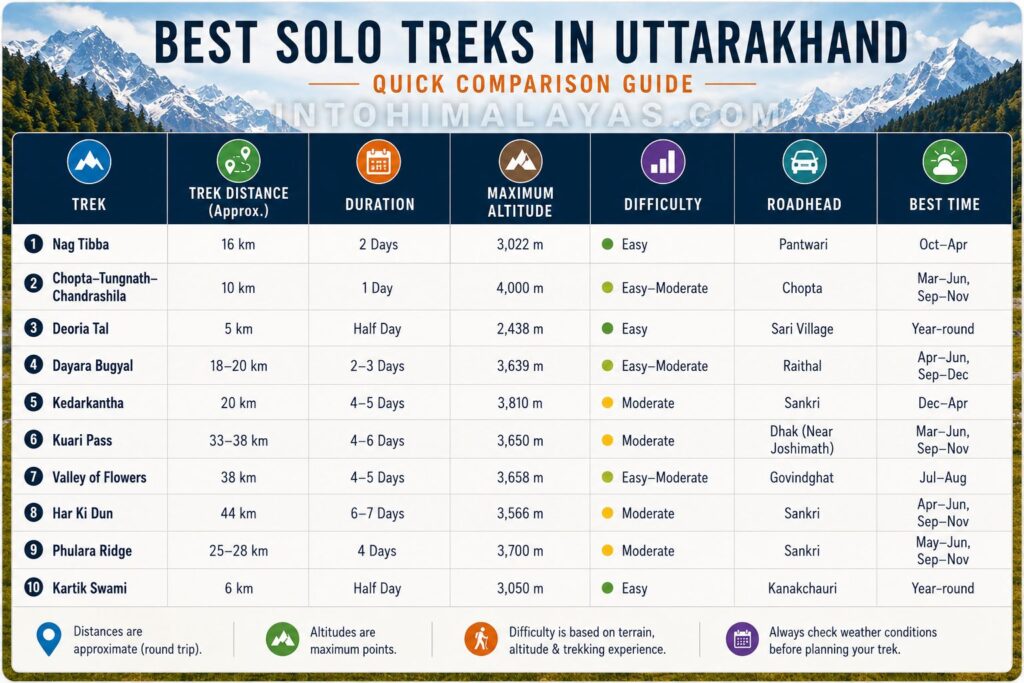
Quick Comparison of the Best Solo Treks in Uttarakhand
Is Uttarakhand Safe for Solo Trekking?
In most cases, yes.
Uttarakhand has a well-established trekking culture, and many of its popular trails pass through villages where tourism has been a source of livelihood for years. You’ll frequently come across local guides, shepherds, homestays and fellow trekkers, especially on routes like Chopta, Nag Tibba and Valley of Flowers.
However, solo trekking doesn’t mean travelling carelessly. Before leaving, always inform someone about your itinerary, carry offline maps, keep enough cash for remote villages and check the latest weather forecast. Mobile networks often disappear once you enter forest sections or higher altitudes, so don’t rely entirely on your phone.
Another important point is to choose a trek that matches your experience. Attempting difficult routes simply because they appear on social media isn’t a good idea. The Himalayas reward preparation far more than confidence.
Choosing the Right Season
Every season transforms the mountains differently.
Spring brings blooming rhododendron forests to trails like Chopta and Dayara Bugyal, while summer opens higher passes after the snow begins to melt. The post-monsoon months between September and November are often considered the best time for trekking, with crystal-clear skies and excellent mountain views.
Winter attracts trekkers looking for snow-covered landscapes, especially on routes like Kedarkantha and Nag Tibba.
The only season I generally avoid for solo trekking is the peak monsoon. While places like the Valley of Flowers are at their most colourful during this period, many other trekking routes become slippery, landslides are more frequent and weather conditions can change within minutes.
1. Nag Tibba Trek – The Best Beginner-Friendly Solo Trek
If someone asked me to recommend just one trek for their first solo Himalayan experience, Nag Tibba would probably be my answer.
Located in the lower Garhwal Himalayas, the trek starts from Pantwari Village, around 90 kilometres from Dehradun and approximately 170 kilometres from Rishikesh. Covering nearly 16 kilometres (round trip), the trek usually takes two days, although experienced hikers sometimes complete it in a single long day.
At an altitude of 3,022 metres, Nag Tibba offers an excellent balance between accessibility and adventure. The trail winds through forests of oak and rhododendron before opening into beautiful clearings that provide sweeping views of Bandarpoonch, Swargarohini, Srikanth and Gangotri peaks.
One reason I often recommend Nag Tibba to first-time solo trekkers is that you rarely feel isolated. During the trekking season, there are usually other trekkers on the trail, along with local villagers and camping groups. Homestays in Pantwari have also made the trek much more convenient for independent travellers who don’t wish to carry camping equipment.
Despite its popularity, Nag Tibba never loses its peaceful charm. Watching the sunrise from the summit after an overnight stay remains one of the most rewarding weekend experiences in Uttarakhand.
2. Chopta–Tungnath–Chandrashila Trek
Few Himalayan treks combine natural beauty and spirituality as effortlessly as the trail leading from Chopta to Chandrashila.
The journey begins from Chopta, located around 210 kilometres from Rishikesh via Rudraprayag and Ukhimath. The complete trek to Tungnath Temple and Chandrashila Peak covers roughly 10 kilometres (round trip) and is usually completed within a day.
Although the distance is relatively short, the trail climbs to nearly 4,000 metres, making it moderately demanding for beginners. Fortunately, the path is paved for much of the route and remains busy with pilgrims and trekkers throughout the main season.
The first stop is Tungnath Temple, recognised as the world’s highest Shiva temple and one of the sacred Panch Kedar shrines. Beyond the temple, the final ascent leads to Chandrashila, where some of the finest panoramic views in Uttarakhand await.
On a clear morning, peaks such as Chaukhamba, Kedarnath, Nanda Devi, Trishul and Neelkanth dominate the skyline. I’ve completed this trek more than once, and each visit feels different depending on the season. Spring brings vibrant rhododendrons, autumn offers crystal-clear mountain views, while winter transforms the landscape into a snow-covered wonderland.
If you’re planning this trek, starting before sunrise is worth every bit of lost sleep. Watching the first rays of sunlight touch the Himalayan peaks from Chandrashila is an experience that stays with you long after the trek ends.
For a more detailed itinerary, you can also explore our complete guides on Chopta, Tungnath Temple and the Chandrashila Trek.
3. Deoria Tal Trek – A Short Trek with Incredible Reflections
Not every memorable trek in Uttarakhand involves climbing above 4,000 metres. Sometimes, a peaceful mountain lake can leave just as strong an impression.
The trek to Deoria Tal begins from Sari Village, which is around 190 kilometres from Rishikesh and about 12 kilometres from Ukhimath. The trail is only 2.5 kilometres one way, making the total trekking distance approximately 5 kilometres.
With a maximum altitude of 2,438 metres, this is one of Uttarakhand’s easiest Himalayan hikes and an excellent option for beginners or solo travellers looking for a relaxed experience.
The gradual stone pathway passes through forests before reaching the beautiful lake, where the snow-covered Chaukhamba massif reflects perfectly in the still water on clear mornings.
Although the trek is short, I always recommend spending some extra time at the lake instead of returning immediately. Early mornings are especially peaceful, with birdsong echoing through the forest while the surrounding peaks slowly emerge from the mist.
For photographers, nature lovers and anyone seeking a quiet introduction to Himalayan trekking, Deoria Tal rarely disappoints.
4. Dayara Bugyal Trek – Endless Alpine Meadows
If your idea of trekking is walking through open grasslands with uninterrupted Himalayan views rather than climbing steep rocky slopes, Dayara Bugyal should be high on your list. Considered one of Uttarakhand’s most beautiful alpine meadows, this trek offers changing landscapes throughout the year—from lush green pastures in summer to snow-covered fields during winter.
The trek begins from Raithal Village, located around 185 km from Dehradun and nearly 200 km from Rishikesh via Uttarkashi. The total trekking distance is approximately 18–20 kilometres, depending on your campsite, and is usually completed in 2 to 3 days. The highest point reaches about 3,639 metres, making it an easy to moderate trek suitable for beginners with a reasonable fitness level.
The trail gradually ascends through oak, maple and rhododendron forests before opening into vast rolling meadows. Unlike many Himalayan treks where the summit is the main attraction, Dayara Bugyal is all about the journey itself. Every turn reveals another stretch of grassland framed by snow-covered peaks.
On clear days, you’ll be treated to magnificent views of Bandarpoonch, Black Peak, Srikanth and the Gangotri range. During spring and early summer, shepherds often bring their livestock to these meadows, adding a glimpse of traditional mountain life to the experience.
One thing I particularly like about Dayara Bugyal is that it never feels overly commercial despite its growing popularity. Even during peak trekking season, the meadow is large enough for everyone to find a quiet corner to simply sit and absorb the surroundings.
For solo trekkers looking to experience Uttarakhand’s famous bugyals without taking on a technically demanding expedition, Dayara Bugyal is an excellent choice.
5. Kedarkantha Trek – Uttarakhand’s Favourite Winter Trek
Ask any trekking enthusiast about winter trekking in India, and Kedarkantha will almost certainly feature in the conversation. Located inside the Govind Pashu Vihar National Park in Uttarkashi district, it has become one of the country’s most sought-after snow treks.
The adventure starts from Sankri Village, approximately 200 km from Dehradun and about 220 km from Rishikesh. The complete trek covers around 20 kilometres over 4 to 5 days, eventually reaching an altitude of 3,810 metres.
The route passes through dense pine forests, frozen streams, picturesque campsites like Juda Ka Talab and Hargaon, before leading to the summit ridge. During winter, thick snow transforms the landscape into a completely different world.
Although Kedarkantha is widely advertised as a beginner’s trek, solo travellers should approach it with realistic expectations. Snow trekking is physically more demanding than trekking on dry trails, and weather conditions can change rapidly. If you’re attempting the trek during peak winter, joining a trekking group or hiring a local guide is the safer option.
Outside the heavy snowfall season, however, experienced solo trekkers will find Kedarkantha immensely rewarding. Standing on the summit at sunrise, surrounded by peaks like Swargarohini, Bandarpoonch, Black Peak and Ranglana, is one of those Himalayan moments that remains etched in memory.
If winter trekking is on your bucket list, Kedarkantha deserves its reputation.
6. Kuari Pass Trek – Walking Through the Curzon Trail
Kuari Pass is often described as one of Uttarakhand’s classic Himalayan treks, and after walking the trail, it’s easy to understand why.
Beginning from Dhak Village, near Joshimath, the roadhead lies around 275 km from Rishikesh. The trek covers roughly 33–38 kilometres over 4 to 6 days, reaching a maximum altitude of approximately 3,650 metres.
Historically known as the Curzon Trail, this route gained prominence after Lord Curzon explored it during the early twentieth century. Today, it remains one of the finest moderate-level treks in the Garhwal Himalayas.
The journey begins through dense forests before gradually entering alpine meadows and high ridges that reveal spectacular views of the Nanda Devi Sanctuary. Throughout the trek, mountains such as Nanda Devi, Dronagiri, Kamet, Hathi-Ghoda and Chaukhamba dominate the horizon.
Unlike shorter weekend treks, Kuari Pass allows you to spend several days immersed in the mountains. Every campsite offers a different perspective, from quiet forest clearings to expansive bugyals where sunrise transforms the surrounding peaks into shades of gold.
Because the trail is well established and receives a steady number of trekkers during the season, experienced solo hikers generally find it manageable. However, if you’re attempting your first multi-day camping trek, hiring a local guide can make the experience much more comfortable.
Kuari Pass isn’t just about reaching the pass itself—it’s about experiencing one of Uttarakhand’s most diverse trekking landscapes.
7. Valley of Flowers Trek – A UNESCO World Heritage Experience
Unlike most Himalayan treks where the objective is reaching a summit, the Valley of Flowers offers something completely different. Here, the destination is a vast alpine valley that bursts into colour for only a few weeks every year.
The trek begins from Govindghat, around 270 km from Rishikesh. After driving to Govindghat, trekkers first travel to Pulna, from where a 19-kilometre trek leads to Ghangaria. From Ghangaria, the Valley of Flowers lies another 3.5 to 4 kilometres away. Including the return journey, the total trekking distance is approximately 38 kilometres, usually completed over 4 to 5 days.
Situated at an altitude of around 3,658 metres, the valley is open only during the monsoon months, generally from June to early October, with July and August being the peak flowering season.
What makes this trek ideal for solo travellers is its excellent infrastructure. Accommodation is available at Ghangaria, hundreds of trekkers visit every day during the season, and the trail is clearly defined. Unlike remote expeditions, you’re rarely walking alone for long stretches.
Once inside the national park, the scenery changes dramatically. Waterfalls cascade down steep cliffs while countless species of alpine flowers cover the valley floor. Depending on when you visit, you may see Himalayan blue poppies, cobra lilies, Himalayan balsam and several varieties of orchids.
Being a UNESCO World Heritage Site also means visitors have a responsibility to protect it. Staying on designated trails, avoiding litter and respecting the fragile ecosystem are essential parts of the experience.
If your itinerary allows, many trekkers extend their journey with a visit to Hemkund Sahib, one of the highest Sikh pilgrimage sites in the world.
One thing you’ll probably notice from these four treks is how different they are from one another. Dayara Bugyal is all about endless meadows, Kedarkantha offers snow-covered forests, Kuari Pass showcases some of the finest Himalayan panoramas, while the Valley of Flowers celebrates the region’s incredible biodiversity. That’s exactly what makes Uttarakhand such a rewarding destination for solo trekkers—no two trails ever feel the same.
8. Har Ki Dun Trek – A Journey Through the Valley of Legends
Some treks impress you with dramatic mountain scenery, while others leave a lasting impression because of the people, villages and culture you encounter along the way. Har Ki Dun belongs firmly in the second category.
Located in the Govind Pashu Vihar National Park, the trek begins from Sankri Village, the same base used for Kedarkantha. Sankri is situated around 200 km from Dehradun and approximately 220 km from Rishikesh. From here, trekkers drive to Taluka before beginning the trek. The complete trail covers around 44 kilometres (round trip) over 6 to 7 days, reaching a maximum altitude of 3,566 metres.
Unlike many Himalayan treks that focus entirely on reaching a summit, Har Ki Dun offers a slower and more immersive experience. The trail follows the Supin River, crosses wooden bridges, passes through dense forests and eventually reaches remote Himalayan villages such as Osla and Gangad, where traditional wooden houses and centuries-old customs continue to shape daily life.
Walking through these villages gives you a glimpse into a side of Uttarakhand that has changed very little over the years. Local people still depend largely on farming, livestock and seasonal tourism, and conversations with villagers often become as memorable as the landscapes themselves.
For solo trekkers who already have some experience, Har Ki Dun is one of the most rewarding multi-day trails in Uttarakhand. The route is well established, homestays are available in several villages, and local guides can be hired if needed.
Reaching the valley itself feels less like conquering a destination and more like arriving in a place that has quietly existed for centuries. Surrounded by snow-covered peaks and alpine meadows, Har Ki Dun reminds you that trekking isn’t always about climbing higher—it is also about understanding the landscape and the people who call it home.
9. Phulara Ridge Trek – One of India’s Finest Ridge Walks
If you’ve already completed treks like Kedarkantha or Dayara Bugyal and want something a little different, Phulara Ridge should be next on your list.
The trek also begins from Sankri, making it easy to combine with other trekking plans in the region. Covering approximately 25–28 kilometres over 4 days, the trail climbs to an altitude of nearly 3,700 metres.
What makes this trek unique is the ridge itself. Instead of climbing to a summit and descending immediately, trekkers spend several kilometres walking along a continuous ridgeline with panoramic views on both sides. It’s a rare experience in the Indian Himalayas and one that feels completely different from conventional trekking routes.
The trail initially passes through thick forests before opening into alpine meadows and eventually reaching the exposed ridge. From here, you’ll enjoy sweeping views of Swargarohini, Bandarpoonch, Kalanag (Black Peak) and the surrounding Himalayan ranges.
Because the trek receives fewer visitors than Kedarkantha, it retains a quieter atmosphere. If you enjoy spending long hours surrounded by mountains without constantly crossing paths with other trekking groups, Phulara Ridge offers exactly that.
Although technically not difficult, the trek requires good stamina and some prior trekking experience. Weather conditions can change quickly along the exposed ridge, so proper planning remains essential for solo travellers.
10. Kartik Swami Trek – A Short Trek with Big Himalayan Views
Not every memorable trek requires carrying a heavy backpack for several days. Sometimes, a short climb can reward you with views that rival much longer expeditions.
The Kartik Swami Trek begins from Kanakchauri Village, located around 40 kilometres from Rudraprayag and approximately 180 kilometres from Rishikesh. The trek itself is only 3 kilometres one way, making the total walking distance around 6 kilometres.
The stone-paved trail gradually climbs through forests before reaching Kartik Swami Temple, situated at an altitude of about 3,050 metres.
Because the route is well maintained and regularly used by pilgrims, it is one of Uttarakhand’s safest short treks for solo travellers. The climb usually takes between one and two hours, depending on your pace.
I’ve always felt that Kartik Swami offers one of the finest rewards for the effort involved. Standing near the temple, you’re greeted by an uninterrupted panorama of peaks including Chaukhamba, Kedarnath, Neelkanth, Trishul and Nanda Ghunti. On a clear winter morning, the entire Himalayan skyline appears remarkably close.
If you’re exploring Rudraprayag district, this trek combines beautifully with visits to Koteshwar Mahadev Temple, Kalimath Temple and Rudraprayag Sangam, making it an excellent addition to a Garhwal itinerary.
Which Solo Trek Should You Choose?
The answer depends entirely on your experience.
If this is your first Himalayan trek, begin with Nag Tibba, Deoria Tal or Kartik Swami. These trails are relatively short, well-marked and frequently visited, making them ideal for building confidence.
Once you’re comfortable trekking independently, move on to routes like Dayara Bugyal, Chopta–Tungnath–Chandrashila or Valley of Flowers, where longer distances and higher altitudes introduce new challenges without becoming overwhelming.
Treks such as Kuari Pass, Har Ki Dun and Phulara Ridge are better suited to trekkers who already have experience with multi-day Himalayan expeditions.
One mistake I often see is people choosing a trek simply because it’s popular on social media. The Himalayas don’t reward rushed decisions. Choosing a trail that matches your fitness and experience almost always leads to a safer and more enjoyable journey.
A Few Things I’ve Learnt While Trekking in Uttarakhand
One thing the Himalayas teach you very quickly is patience.
You cannot rush a mountain trail the way you rush through city life. Sometimes the weather forces you to slow down. Sometimes a local shepherd points you towards a better viewpoint that isn’t marked on any map. Sometimes sharing tea with a family running a small homestay becomes the most memorable part of the trip.
Whenever I trek in Uttarakhand, I try to support local businesses whenever possible. Staying in village homestays, eating at small local cafés and hiring guides when needed not only supports the local economy but also gives you a much richer understanding of the region.
Travel responsibly too. Carry your waste back, avoid playing loud music on the trail and remember that many of these routes pass through villages and sacred sites. Respecting local customs is just as important as respecting the mountains themselves.
Conclusion
Uttarakhand offers some of the finest solo trekking opportunities in India, but the best trek isn’t always the highest or the most difficult. It’s the one that matches your experience, allows you to enjoy the journey safely and leaves you with memories you’ll carry long after returning home.
Whether it’s watching the sunrise from Nag Tibba, walking through the alpine meadows of Dayara Bugyal, admiring the flowers of Valley of Flowers, or standing at Kartik Swami as the Himalayan peaks glow in the evening light, each trek offers something unique.
Solo trekking isn’t about being alone. It’s about discovering a different rhythm of travel—one where the mountains decide the pace, and you’re simply there to experience them.
Frequently Asked Questions
Which is the best solo trek in Uttarakhand for beginners?
Nag Tibba, Deoria Tal and Kartik Swami are among the best beginner-friendly solo treks due to their short distances, well-defined trails and relatively easy terrain.
Is solo trekking safe in Uttarakhand?
Yes, provided you choose appropriate trails, monitor weather conditions, inform someone about your itinerary and avoid attempting difficult high-altitude routes beyond your experience.
Which trek has the best Himalayan views?
Chandrashila, Kuari Pass and Kartik Swami are known for their exceptional panoramic views of peaks like Chaukhamba, Nanda Devi, Kedarnath and Neelkanth.
Can beginners do Kedarkantha alone?
Outside the winter snow season, experienced hikers may trek independently with proper planning. During peak winter, beginners should consider joining an organised trek or hiring a local guide.
What is the best time for solo trekking in Uttarakhand?
The post-monsoon season (September to November) generally offers the clearest skies and stable weather. Spring (March to May) is also excellent, while winter is best for snow treks like Kedarkantha.
Which solo trek is best for a weekend?
Nag Tibba, Deoria Tal, Chopta–Tungnath–Chandrashila and Kartik Swami are ideal weekend treks because they require only one or two days and are easily accessible by road.
By – Rohit Thapliyal
for intohimalayas
Winter Char Dham Yatra in Uttarakhand: Where the Gods Go After the Temples Close
Tilu Rauteli: The Warrior Princess of Garhwal | History, Story & Legacy

Madho Singh Bhandari: The Brave Warrior and Engineer of Garhwal
Baijnath Temple Kangra: Shravan Celebrations at the Ancient Stone Abode of Shiva
Sham Valley Trek Ladakh – The Best Easy Monsoon-Proof Homestay Trek in the Himalayas
Hampta Pass Trek in July: A Journey from Green Monsoon Valleys to the Desert of Spiti
Best Solo Treks in Uttarakhand: 10 Himalayan Trails for Every Kind of Trekker
Kilkileshwar Mahadev Temple, Srinagar Garhwal: A Peaceful Shiva Shrine Overlooking the Alaknanda