Koteshwar Mahadev Temple, Rudraprayag: A Complete Guide to the Sacred Cave Shrine of Lord Shiva
By – Rohit Thapliyal

Table of Contents
Nestled on the banks of the Alaknanda River, just about 3 kilometres from Rudraprayag town, Koteshwar Mahadev Temple is one of the lesser-known yet significant Shiva shrines in Uttarakhand. Unlike the grand stone temples that define the Char Dham circuit, Koteshwar is centred around a natural cave where Lord Shiva is worshipped in the form of a naturally occurring Shivling. The temple attracts local devotees throughout the year and is also visited by pilgrims travelling towards Kedarnath and Badrinath who wish to include another sacred stop on their journey.
The peaceful surroundings, the sound of the Alaknanda flowing below the rocky cliffs, and the simplicity of the cave temple make Koteshwar different from many other religious sites in the state. There are no large temple complexes or elaborate structures here. Instead, visitors descend a flight of steps to reach a cave that has been associated with Lord Shiva for generations through local traditions and religious belief.
Although it is often included in travel itineraries around Rudraprayag, Koteshwar Mahadev is more than just a sightseeing stop. For the people of Garhwal, it remains an active place of worship where prayers, daily rituals and local faith continue much as they have for decades.
Location and Accessibility
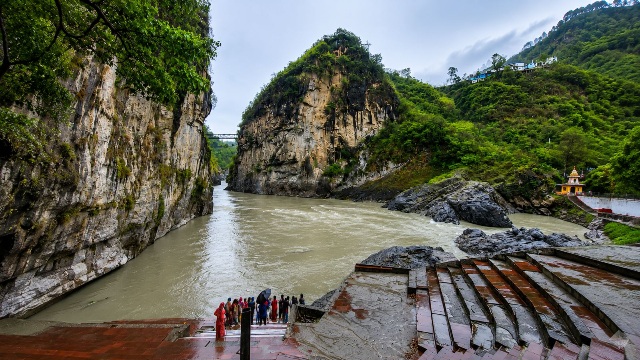
Koteshwar Mahadev Temple is situated approximately 3 kilometres from Rudraprayag on the Rudraprayag–Badrinath National Highway. A short diversion from the highway leads to the temple entrance, from where visitors descend a series of steps to reach the cave.
The temple overlooks the Alaknanda River, which flows through a narrow rocky gorge below. Surrounded by hills and natural rock formations, the setting is quiet despite its proximity to the highway. During the monsoon, the river appears particularly powerful, while the surrounding hills turn lush green. In winter and spring, the area offers a calm atmosphere, making it a pleasant stop for pilgrims and travellers alike.
Because the temple is located close to Rudraprayag town, many visitors combine it with other nearby attractions such as Rudraprayag Sangam and Dhari Devi Temple.
History and Mythological Significance
Unlike many ancient temples in Uttarakhand, Koteshwar Mahadev does not have inscriptions or historical records that clearly establish when worship first began here. Since the shrine is built around a natural cave rather than a constructed temple, its significance has largely been preserved through local traditions and oral history.
The temple is closely associated with a popular legend involving Lord Shiva and the demon Bhasmasura. According to Hindu mythology, Bhasmasura performed severe penance to please Lord Shiva and received a boon that allowed him to reduce anyone to ashes by placing his hand on their head. After obtaining the boon, the demon became arrogant and attempted to use it against Lord Shiva himself.
Local tradition in Rudraprayag holds that Shiva sought refuge in this cave while escaping from Bhasmasura. It is believed that he spent some time here in meditation before moving further into the Himalayas. Eventually, Lord Vishnu took the form of Mohini, distracted Bhasmasura through dance, and caused the demon to place his own hand upon his head, leading to his destruction.
While this story appears in different forms across India, the association of the cave at Koteshwar with this episode is a regional belief that has been passed down through generations. It continues to be an important part of the temple’s identity and is often narrated by local priests and residents.
Many devotees also believe that sages and ascetics meditated in this cave centuries ago. Although these traditions cannot be historically verified, they contribute to the temple’s long-standing reputation as a place of meditation and quiet worship.
Why is it Called Koteshwar?
The name “Koteshwar” is commonly explained through local belief. The Sanskrit word Koti can mean “countless” or “crore,” while Ishwar refers to Lord Shiva.
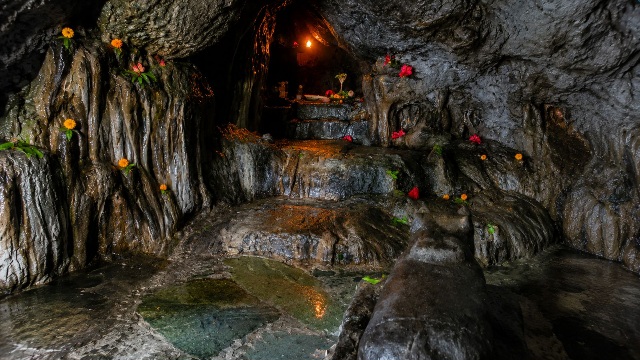
Inside the cave, visitors can see numerous naturally formed rock projections resembling small Shivlings. According to local tradition, these formations are so many in number that the deity came to be known as Koteshwar Mahadev—the Lord of Countless Shivlings.
These formations have developed naturally over time through geological processes inside the cave. For devotees, however, they are regarded as self-manifested symbols of Lord Shiva rather than ordinary rock formations. This unique characteristic makes Koteshwar different from many other Shiva temples, where the main deity is sculpted or installed by priests.
Inside the Cave Temple
The most distinctive feature of Koteshwar Mahadev is its natural cave. After descending the staircase, visitors enter a narrow rock chamber illuminated by electric lights and traditional oil lamps. The cave remains cool throughout the year due to the surrounding rock and natural moisture.
At the centre of the cave is the principal Shivling, where daily worship is performed. Water continuously drips from the cave roof onto the Shivling, a natural phenomenon that devotees regard as an eternal Jalabhishek. Around the main shrine, several naturally formed rock structures resembling Shivlings can be seen along the cave walls and floor.
Unlike larger pilgrimage centres where devotees often move quickly through queues, Koteshwar generally offers a more relaxed experience. Visitors spend a few moments offering prayers before quietly observing the cave and its natural formations.
The temple does not rely on grand architecture to leave an impression. Its appeal lies in the simplicity of the natural cave, the sound of flowing water and the peaceful surroundings created by the nearby Alaknanda River.
Daily Worship and Religious Importance
Koteshwar Mahadev remains an active temple where regular worship is performed throughout the year. Priests conduct daily rituals that include offering water, milk, flowers and bilva leaves to the Shivling. Local residents frequently visit the temple, especially on Mondays, which are traditionally considered auspicious for the worship of Lord Shiva.
Many pilgrims travelling towards Kedarnath also stop here to seek blessings before continuing their journey into the higher Himalayas. Although visiting Koteshwar is not a mandatory part of the Kedarnath pilgrimage, it has become a customary stop for many devotees because of its proximity to the route.
The temple’s religious significance is therefore rooted not only in mythology but also in its continued role as a place of worship for the local community and travelling pilgrims.
Festivals and Important Occasions
Although Koteshwar Mahadev Temple receives visitors throughout the year, the number of devotees increases during Mahashivratri and the holy month of Shravan (Sawan). On these occasions, special prayers and Rudrabhishek are performed, and devotees from Rudraprayag and nearby villages visit the temple to offer milk, water, bilva leaves and flowers to Lord Shiva.
Mondays are considered especially auspicious for Shiva worship, and the temple generally sees more local devotees on these days. Compared to the larger pilgrimage centres of Uttarakhand, however, Koteshwar remains relatively peaceful. Even during festivals, the atmosphere is devotional rather than crowded, allowing visitors to spend time inside the cave without feeling rushed.
Local Beliefs Associated with the Temple
Like many ancient temples in the Garhwal Himalayas, Koteshwar Mahadev is closely connected with local traditions that have been preserved through generations.
One widely held belief is that Lord Shiva meditated in this cave after escaping from Bhasmasura. Although this story is part of local tradition rather than documented history, it continues to shape the temple’s identity and is narrated by priests to visitors.
Many local residents also believe that offering prayers here before beginning an important journey or undertaking a significant life event brings blessings from Lord Shiva. Since the temple lies on the route towards Kedarnath, some pilgrims choose to stop here before continuing their yatra.
Another feature that attracts devotees is the continuous dripping of water from the cave roof onto the main Shivling. This natural occurrence is regarded as a sacred and uninterrupted Jalabhishek, symbolising nature’s own offering to Lord Shiva.
For locals, Koteshwar is not merely a tourist destination but an active place of worship that remains deeply connected with the religious life of the region.
Best Time to Visit
Koteshwar Mahadev Temple can be visited throughout the year, as it is located at a relatively low altitude and remains accessible in all seasons.
The months from October to March are particularly pleasant, with cool weather and clear skies that make travelling around Rudraprayag comfortable. This period is ideal for visitors who wish to explore nearby attractions without the heavy rush of the Char Dham pilgrimage season.
From April to June, the temple receives a steady flow of pilgrims travelling towards Kedarnath and Badrinath. The weather remains favourable, making it convenient to include Koteshwar in a Char Dham itinerary.
During the monsoon (July to September), the surrounding hills become lush green and the Alaknanda River flows with impressive force. While the scenery is beautiful, travellers should exercise caution as heavy rainfall may lead to slippery steps and occasional road disruptions in the region.
Temple Timings and Visitor Information
The temple generally opens in the morning and remains accessible until evening, with a break during the afternoon depending on temple activities and local management. Since timings may vary during festivals or special religious occasions, it is advisable to confirm locally before planning a visit.
There is no entry fee to visit the temple. Visitors are expected to maintain the sanctity of the cave by avoiding loud conversations and respecting ongoing prayers.
The staircase leading to the cave is well-maintained but may be slightly slippery during the rainy season, so comfortable footwear with a good grip is recommended.
How to Reach Koteshwar Mahadev Temple
Reaching Koteshwar Mahadev is straightforward, especially for those already travelling in the Garhwal region.
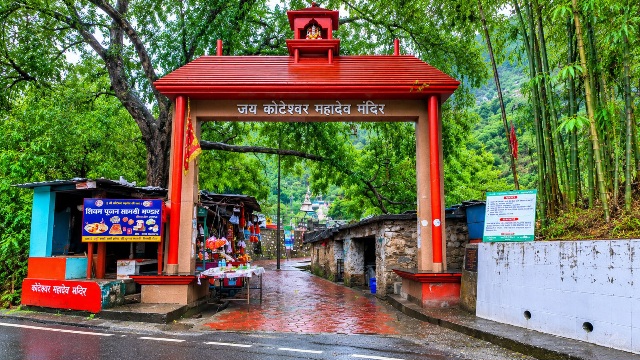
From Rudraprayag, the temple is only about 3 kilometres away and can be reached by private vehicle or local taxi within a few minutes. Parking is available near the entrance, from where visitors descend a flight of steps to the cave.
The nearest major towns are Srinagar Garhwal, approximately 35 kilometres away, and Rishikesh, about 140 kilometres from Rudraprayag. Regular buses and shared taxis connect these towns with Rudraprayag throughout the year.
The nearest railway stations are Rishikesh and Haridwar, while Jolly Grant Airport near Dehradun serves as the closest airport for travellers arriving by air.
Because of its location on the Char Dham route, Koteshwar Mahadev can easily be included in an itinerary that covers Rudraprayag, Guptkashi and Kedarnath.
Nearby Places to Visit
A visit to Koteshwar Mahadev can be combined with several important attractions around Rudraprayag.
Rudraprayag Sangam, where the Alaknanda and Mandakini rivers meet, is one of the Panch Prayags and holds immense religious significance. The confluence is just a short drive from the temple and offers scenic views along with a peaceful riverside atmosphere.
About 20 kilometres away is Dhari Devi Temple, dedicated to Goddess Kali and regarded as one of Uttarakhand’s important Shakti shrines. Many travellers visit both temples on the same day.
Pilgrims continuing towards Kedarnath pass through Agastyamuni, Guptkashi, Ukhimath and Sonprayag, all of which have their own religious and historical importance. you can check my detailed article on “Omkareshwar Temple Ukhimath : Winter Home of Kedarnath” as well.
Those interested in spending more time in Rudraprayag can also explore local markets and viewpoints overlooking the river valleys.
Tips for Visitors
A visit to Koteshwar Mahadev is relatively simple, but a few practical suggestions can make the experience more comfortable.
Wear comfortable footwear, as reaching the cave involves walking down and climbing back up a series of steps. During the monsoon, these steps may become wet.
Since the cave is compact, visitors should avoid blocking the passage and allow others to offer prayers comfortably. Photography may be restricted inside the sanctum, so it is best to follow the instructions of the temple authorities.
Early morning or late afternoon generally offers a quieter atmosphere and pleasant weather, especially during the summer months.
As with any religious place in Uttarakhand, visitors are encouraged to help keep the surroundings clean by avoiding plastic waste and disposing of litter responsibly.
Conclusion
Koteshwar Mahadev Temple may not be among the most famous shrines of Uttarakhand, but its significance lies in its simplicity and long-standing association with local faith. Built around a natural cave on the banks of the Alaknanda River, it offers a different experience from the larger temple complexes found across the state.
Its connection with the legend of Lord Shiva and Bhasmasura, the naturally formed Shivling-like rock formations inside the cave, and the peaceful setting together make it an interesting place to visit for both pilgrims and travellers exploring Rudraprayag.
Whether you stop here while travelling to Kedarnath or visit it as part of a journey through the Garhwal Himalayas, Koteshwar Mahadev offers an opportunity to experience one of the region’s quietly revered Shiva shrines. Rather than impressing visitors with grandeur, the temple leaves a lasting impression through its natural setting, continued tradition of worship, and the enduring faith of the local community.
– Rohit Thapliyal
for Intohimalayas
(08 July 2026)

Winter Char Dham Yatra in Uttarakhand: Where the Gods Go After the Temples Close

Tilu Rauteli: The Warrior Princess of Garhwal | History, Story & Legacy

Madho Singh Bhandari: The Brave Warrior and Engineer of Garhwal

Baijnath Temple Kangra: Shravan Celebrations at the Ancient Stone Abode of Shiva

Sham Valley Trek Ladakh – The Best Easy Monsoon-Proof Homestay Trek in the Himalayas

Hampta Pass Trek in July: A Journey from Green Monsoon Valleys to the Desert of Spiti

Best Solo Treks in Uttarakhand: 10 Himalayan Trails for Every Kind of Trekker

Kilkileshwar Mahadev Temple, Srinagar Garhwal: A Peaceful Shiva Shrine Overlooking the Alaknanda