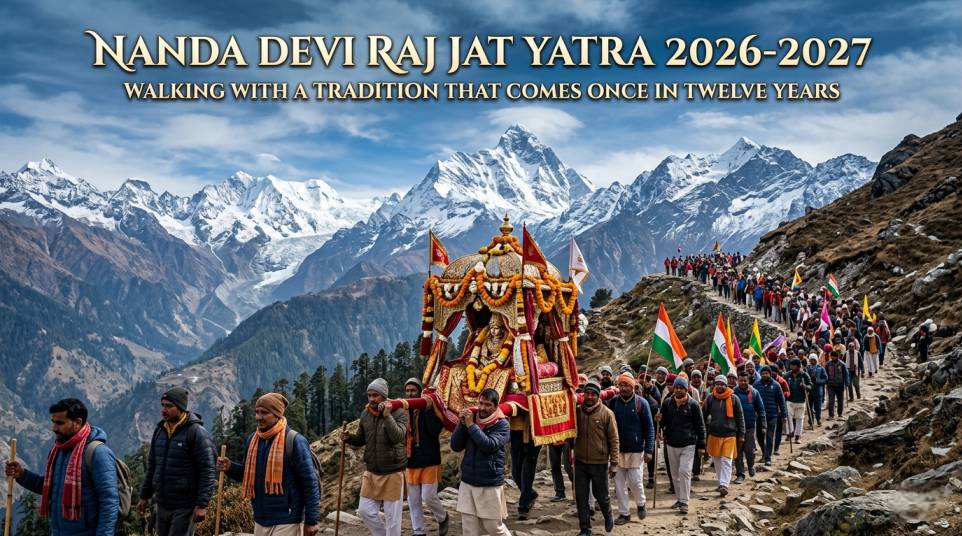
In the mountains of Uttarakhand, some journeys don’t begin with a plan—they begin with a belief. The Nanda Devi Raj Jat Yatra is one of those rare traditions where the line between mythology and real life almost disappears. You don’t just hear stories about it; you see them unfold step by step, village by village, over days that feel longer than time itself.
Every twelve years, this yatra quietly returns. There is no rush, no loud promotion, no attempt to make it something modern. And maybe that is why it still feels real. People don’t come here just to witness it. They become part of it.
At its heart, this is not just a pilgrimage. It is the symbolic farewell of a daughter—Goddess Nanda Devi—leaving her maternal home and returning to the abode of Lord Shiva. And somewhere along the way, it starts to feel less like a religious event and more like something deeply human.
Where the Journey Begins
The yatra starts from Nauti village in Chamoli district, a place that remains simple and quiet for most of the year. But when the Raj Jat begins, it transforms into something else entirely. It becomes the starting point of a journey that connects hundreds of villages and thousands of people through a shared sense of devotion.
Rituals are performed, prayers are offered, and slowly the procession begins to move. There is no urgency. The pace is set by tradition, not time.
The Complete Route of Nanda Devi Raj Jat Yatra (All Halts & Stages)
The journey of the Nanda Devi Raj Jat unfolds gradually across villages, forests, and high-altitude terrain. Each halt carries its own importance, and together they form a continuous path of devotion.
Day 1–2: The Beginning and Return Ritual
Nauti → Ida Badhani → Nauti
The yatra begins from Nauti with rituals and prayers, moves to Ida Badhani for the first halt, and then returns to Nauti. This return is symbolic, marked by a night-long jagar before the actual departure begins.
Day 3–5: Moving Deeper into the Region
Nauti → Kansuwa → Sem
The journey resumes and passes through Kansuwa before reaching Sem. By this stage, the rhythm of the yatra settles, and devotional singing continues through the night halts.
Day 5–7: Entering Traditional Villages
Sem → Koti → Bhagoti
These halts are culturally active, where local communities participate in rituals and welcome the procession.
Day 7–8: A Key Religious Halt
Bhagoti → Kulsari
Kulsari is one of the most important stops, where major rituals are performed before moving further into the higher regions.
Day 8–9: Transition Towards Upper Regions
Kulsari → Chepdue (Dewal region)
This stretch marks a gradual shift in terrain, preparing the yatra for the upcoming climb.
Day 9–10: Garhwal Meets Kumaon
Chepdue → Nandakesari
At Nandakesari, deities and devotees from Kumaon join the yatra, significantly increasing its scale and energy.
Day 10–11: Moving Through Scenic Terrain
Nandakesari → Faldiya → Mundoli
This stretch passes through beautiful landscapes, with Mundoli serving as an important ritual halt where havan is performed.
Day 11–12: The Major Assembly Point
Mundoli → Wan
Wan village becomes a major gathering point where hundreds of chantolis assemble. Rituals for Latu Devta are performed here before entering deeper Himalayan terrain.
Day 12–13: Entering Dense Forest Zones
Wan → Gehroli Patal
The route becomes more physically demanding, with forest trails and steeper climbs.
Day 13–15: The Meadow That Pauses the Journey
Gehroli Patal → Bedni Bugyal
At Bedni Bugyal, the yatra halts for a few days. A fair is held, rituals are performed, and traditional dances take place in this vast alpine meadow.
Day 15–16: Towards the High-Altitude Zone
Bedni Bugyal → Pathar Nachoni → Roopkund
This stretch becomes steep and rugged. Roopkund, known for its skeletal remains, adds a mysterious and silent atmosphere to the journey.
Day 16–17: The Toughest Stretch
Roopkund → Shila Samudra
One of the most challenging parts of the yatra, with rocky terrain, high altitude, and unpredictable weather conditions.
Day 17–19: The Final Destination
Shila Samudra → Homkund
The yatra reaches its final destination at Homkund, where the concluding rituals take place and the sacred ram is released.
Return Journey
Homkund → Sutol → Nauti
After completion, the procession returns towards Sutol and eventually back to Nauti, marking the end of the journey.
The Route: A Journey That Moves Like a Story
The Nanda Devi Raj Jat Yatra does not follow a route in the usual sense. It unfolds gradually, almost like a story moving forward with pauses, emotions, and transitions.
From Nauti, the procession first moves towards Ida Badhani, where the goddess is welcomed in a traditional way. It is a short stretch, but it sets the tone for what lies ahead. Interestingly, the yatra returns briefly to Nauti after this halt. This return feels symbolic, almost like a final moment before the real departure begins. A night-long jagar takes place here, with devotional singing that continues till morning.
After this, the journey truly moves forward. The route passes through Kansuwa and reaches Sem, where the rhythm of the yatra becomes more settled. By now, the group has grown, and the nights are filled with songs, stories, and rituals that connect people across regions.
From Sem, the procession continues towards Koti and Bhagoti. These are not just stops but living parts of the tradition, where local communities actively participate. The terrain begins to change here, with longer walks and deeper forest sections.
The next important halt is Kulsari, a place of strong religious significance. Rituals performed here are considered essential for the continuation of the yatra. From Kulsari, the path moves towards Chepdue (near Dewal), marking a gradual transition towards higher Himalayan terrain.
As the yatra progresses, it reaches Nandakesari, one of the most important points along the route. This is where deities and devotees from the Kumaon region join the procession. The scale of the yatra expands, and the sense of unity between regions becomes clearly visible.
From here, the journey continues through Faldiya and reaches Mundoli. These stretches are scenic but also prepare the pilgrims for more demanding terrain ahead. At Mundoli, important havan rituals are performed before entering deeper Himalayan sections.
The procession then moves towards Wan village, which acts as a major assembly point. By this stage, hundreds of chantolis from different regions have joined, and the magnitude of the yatra becomes evident. Wan is also associated with Latu Devta, the guardian deity, and rituals here are considered necessary before moving further.
Beyond Wan, the journey becomes physically more challenging. The route leads towards Gehroli Patal, where the forests grow denser and the climbs become steeper. The crowd naturally spreads out as the terrain begins to test endurance.
The next halt is Bedni Bugyal, one of the most breathtaking alpine meadows in Uttarakhand. Here, the yatra slows down. A fair takes place, rituals are performed, and for a few days, the journey feels almost celebratory. Traditional dances and cultural programs bring a different energy to the yatra.
From Bedni, the path moves towards Pathar Nachoni and then to Roopkund. This section is steep and exposed, and the environment turns rugged. Roopkund, known for its skeletal remains, adds a mysterious silence to the journey. Offerings are made here before moving ahead.
The next stretch towards Shila Samudra is among the toughest. The altitude increases significantly, the terrain becomes rocky, and the conditions are unpredictable. By this point, the journey is no longer just physical—it becomes mental.
Finally, the yatra reaches Homkund, the last destination. Surrounded by towering Himalayan peaks, this is where the final rituals take place. A sacred fire ceremony is performed, offerings are made, and the four-horned ram is released into the wild. This marks the symbolic completion of the goddess’s journey.
After this, the return begins towards Sutol and eventually back to Nauti, but the essence of the journey remains behind in the mountains.
The Meaning Behind the Yatra
Nanda Devi is worshipped as an incarnation of Goddess Parvati, but in the hills, she is remembered as a daughter. The yatra represents her departure after marriage—a moment deeply understood in Himalayan culture.
For generations, women here have left their homes to settle in distant mountain villages. The story of Nanda Devi reflects that same emotion—of separation, adjustment, and quiet strength. This is why the yatra feels so personal to the people who take part in it.
Rituals That Define the Journey
The presence of the four-horned ram, known as the Chausingha Khadu, remains one of the most unique aspects of the yatra. It leads the procession and carries sacred offerings, believed to be chosen by divine will.
Alongside it, hundreds of chantolis are carried by devotees, many of whom walk barefoot. At night, jagars continue in different villages, where stories and songs are passed down through generations.
These are not performances. They are traditions that are still lived.
How to Reach Nauti Village
Reaching Nauti requires some planning due to its remote location in Chamoli district.
By air, the nearest airport is Jolly Grant Airport in Dehradun, located around 200 kilometers away. From there, taxis and buses are available towards Chamoli and Karnaprayag.
By train, Rishikesh and Haridwar are the nearest railway stations. Both are well connected to major cities, and from there, road transport can take you further into the hills.
By road, Nauti is connected via NH-7 through Rishikesh, Rudraprayag, and Karnaprayag. The last stretch is accessible through local transport.
It is always better to reach early, keeping buffer time for weather and road conditions.
Preparation and Reality of the Journey
This is not an easy yatra. The route involves long walking days, high altitudes, and unpredictable weather. Preparing physically is important, but mental readiness matters just as much.
The journey reaches altitudes close to 5,000 meters, making acclimatization essential. Carrying proper gear, maintaining fitness, and understanding the cultural significance of the yatra are all part of the preparation.
A Larger Spiritual Circuit
If you are exploring Uttarakhand’s spiritual routes, places like Badrinath Temple, Madhyamaheshwar Temple, and Jageshwar Dham each offer their own experiences.
But the Nanda Devi Raj Jat feels different. It is not about reaching a temple. It is about walking with a tradition.
You can also explore the broader Char Dham Yatra, but even within that, this journey stands apart in its depth.
Final Thoughts
The Nanda Devi Raj Jat Yatra 2026-2027 is not something that can be recreated or repeated easily. It happens once in twelve years, and then it disappears back into silence.
If you choose to be part of it, don’t go with expectations of comfort or convenience. Go with patience. Go with respect.
Because in the end, this is not just a journey through the Himalayas.
It is a journey through something that has survived time itself.
If this journey connects with you, you can continue exploring places like Badrinath Temple, Madhyamaheshwar Temple, and Jageshwar Dham, or plan the complete Char Dham Yatra to experience the spiritual side of the Himalayas more deeply.
-by Rohit Thapliyal
for intohimalayas

Winter Char Dham Yatra in Uttarakhand: Where the Gods Go After the Temples Close

Tilu Rauteli: The Warrior Princess of Garhwal | History, Story & Legacy

Madho Singh Bhandari: The Brave Warrior and Engineer of Garhwal

Baijnath Temple Kangra: Shravan Celebrations at the Ancient Stone Abode of Shiva

Sham Valley Trek Ladakh – The Best Easy Monsoon-Proof Homestay Trek in the Himalayas